

Search · Explained
SEO vs AEO vs GEO
Three acronyms, one search result page. What each one actually changes, where the terms came from, and why good pages stay invisible when only one of them is done.
Search changed shape, and the vocabulary changed with it. Ten years ago a page was either ranked or it was not. Today the same page can sit at position four, be quoted in the answer box above it, and be named as a source in an AI summary that a customer reads somewhere else entirely.
So three terms turned up: SEO, AEO and GEO. They are not three separate industries and they are not rivals. They are three layers of the same job, and most of the confusion comes from people selling one layer as if it replaces the others.
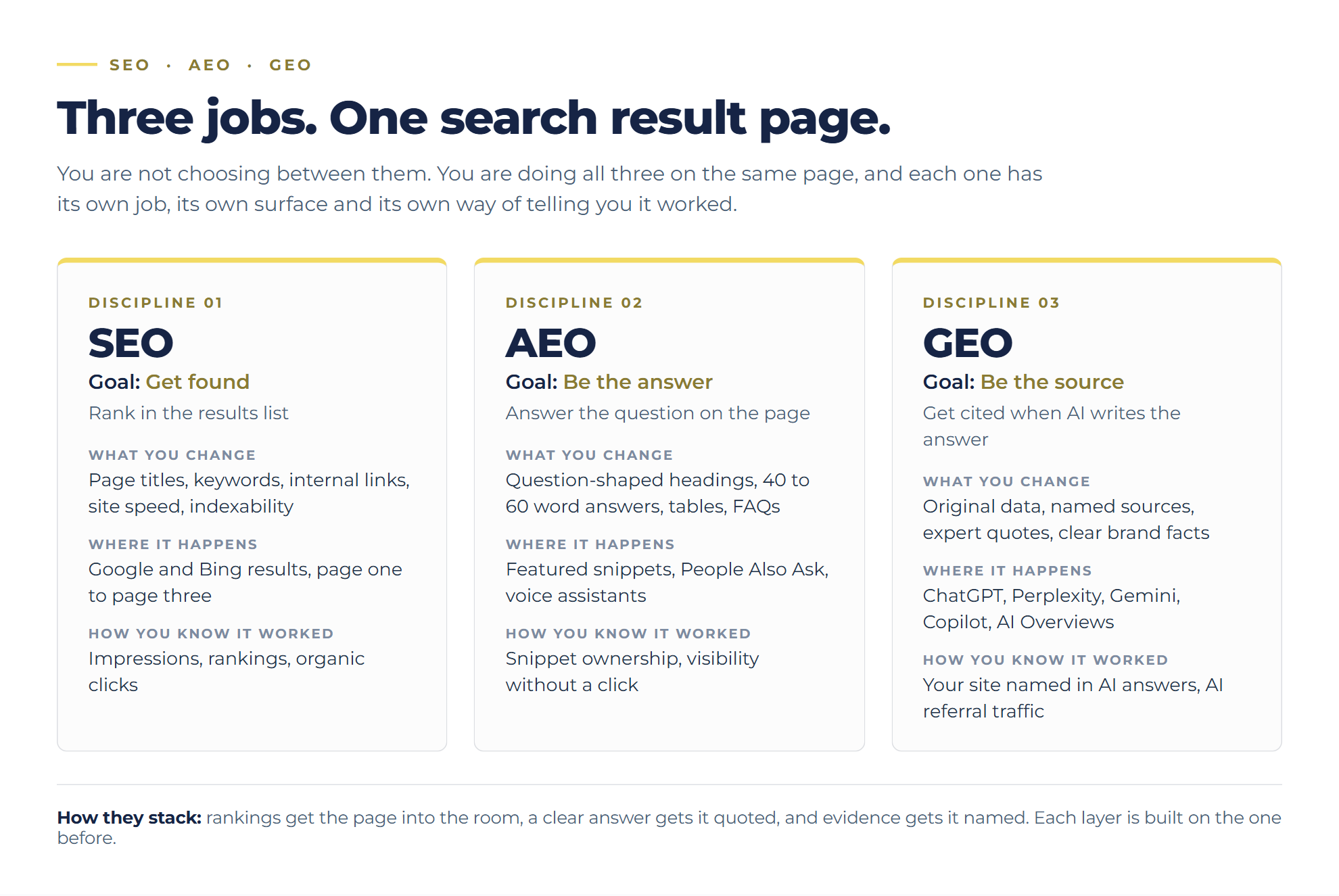
The short answer: SEO gets your page into the results. AEO gets it quoted as the direct answer. GEO gets it cited when an AI engine writes or summarises an answer. You need SEO for the other two to be possible at all.
What each one means
SEO: Search Engine Optimisation
SEO is the work of getting a page to rank in a search engine’s results for what people search. That covers technical health (crawlable, fast, indexed), the words on the page matching real demand, internal links that show which pages matter most, and enough authority that the engine trusts your page over the alternatives. Success is measured in positions, impressions and clicks.
AEO: Answer Engine Optimisation
AEO is the work of being picked as the answer rather than as one of ten links. It shows up as featured snippets, People Also Ask entries, voice assistant replies and the answer panels inside search results. What it rewards is structure: one question per heading, the direct answer in the first sentence underneath, and facts that still make sense after being lifted out of the page.
GEO: Generative Engine Optimisation
GEO is the work of being cited when a generative AI tool answers a question. Those tools, including ChatGPT, Perplexity, Gemini, Copilot and Google’s AI Overviews, assemble an answer from several sources and name some of them. What it rewards is evidence: numbers with sources, named expertise, clear statements about who you are and what you do, and enough third-party mentions that the model recognises your name.
Where the three terms came from
The acronyms have very different histories, which is part of why they get used so loosely.
SEO dates back to the mid-1990s, when people started adjusting pages for the first web search engines. Three decades of practice, a whole vocabulary and a mature tool industry sit behind it.
AEO is newer and less formal. It grew out of the industry as featured snippets, People Also Ask and voice assistants spread, because those surfaces reward something different from a ranking. There is no founding paper and no single author, and Google does not use it as an official product name.
GEO does have a founding paper. The term was coined in “GEO: Generative Engine Optimization” by Pranjal Aggarwal, Vishvak Murahari, Tanmay Rajpurohit, Ashwin Kalyan, Karthik Narasimhan and Ameet Deshpande, posted in November 2023 and published at the ACM SIGKDD conference in 2024. The authors built a benchmark of 10,000 queries and tested what actually shifts visibility inside generative answers. Adding citations helped most, at up to about 40 percent, with statistics and direct quotations close behind. Keyword stuffing made things worse.
That last finding is the useful part. The tactics that lift AI visibility are the ones that make a page more useful to a person, not the ones that repeat a phrase often enough.
Sources: GEO: Generative Engine Optimization (arXiv 2311.09735) and Google’s AI features documentation.
The same question, three different layers
Take a real query: “best running shoes for flat feet in Malaysia”. Three things have to happen before your page reaches that customer.
- The index layer (SEO). A crawler finds the page, decides what it is about and where it belongs in the results. If the page is not indexed, nothing further down this list can happen.
- The answer layer (AEO). One clean passage gets pulled out and shown as a snippet, a People Also Ask item or a spoken reply. The engine needs a sentence that survives the trip.
- The citation layer (GEO). An AI model retrieves several pages, writes its own answer and names the sources it used. It names what it can verify, not what shouts loudest.
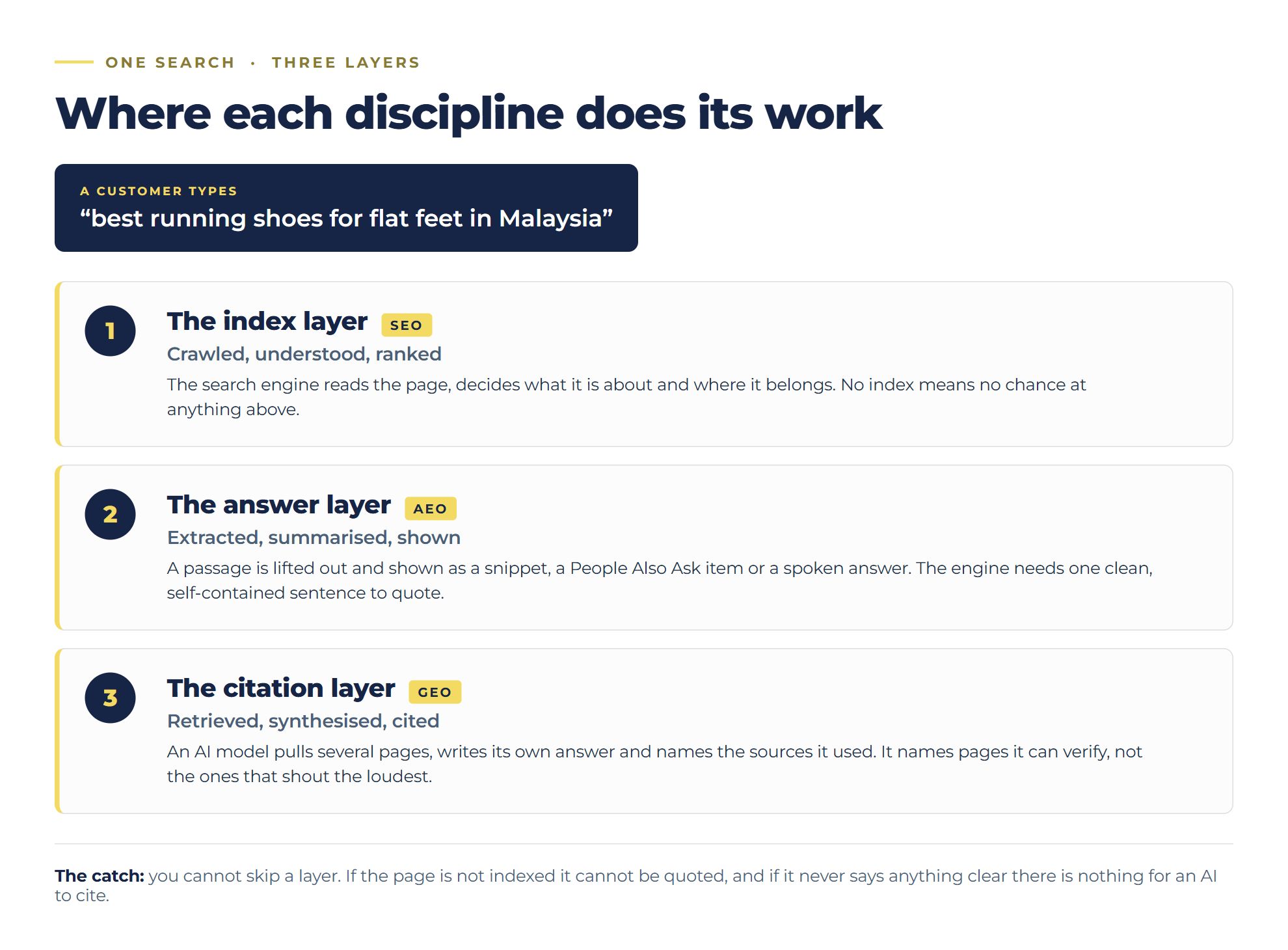
The order matters. A page that is not indexed cannot be quoted, and a page that never states a clear answer gives an AI engine nothing worth citing. Each layer is built on the one above it.
What actually changes in the work
The day-to-day work overlaps a lot, which is why the three get bundled together in agency decks. The differences are in what you produce and how you check it.
| SEO | AEO | GEO | |
|---|---|---|---|
| What you optimise | The page as a ranking candidate | The passage as an extractable answer | The page as a verifiable source |
| Content shape | Topic coverage, titles, internal links | Question headings, 40 to 60 word answers, lists, tables | Original data, named sources, expert quotes, clear definitions |
| Technical work | Crawlability, speed, canonicals, mobile | Schema markup, clean heading hierarchy, FAQ sections | Access for AI crawlers, HTML that renders without JavaScript |
| Where you see it | Search results pages | Snippets, People Also Ask, voice replies | ChatGPT, Perplexity, Gemini, Copilot, AI Overviews |
| What you measure | Rankings, impressions, clicks | Snippet and answer box wins, visibility without a click | Citations in AI answers, brand mentions, AI referral traffic |
Where they overlap, and where the debate gets silly
Google has been unusually direct about its own side of this. Its documentation says there are no additional technical requirements to appear in AI Overviews or AI Mode. A page has to be indexed, eligible to show a snippet and good enough to be selected. The same index serves both, AI Overviews are grounded in normal Search results, and AI Mode splits a question into several sub-queries and retrieves against the same ranking systems.
In plain terms, on Google the SEO work is the entry ticket, and AEO and GEO describe what you do to make the most of being in the room. Anyone selling “GEO only” or “AEO instead of SEO” is selling you the top half of a ladder.
The real differences sit outside Google. ChatGPT, Perplexity, Claude and Copilot pull sources from a much wider pool than page one, so a specific, well-evidenced page on a site with modest authority can be quoted there while sitting on page two in Google. That is the genuine opportunity in GEO, and it is why the discipline exists at all.
Five checks that tell you which one you are missing
- Is the page indexed? Search your exact title in quotes. If your page does not appear, no answer box and no AI engine will find it either. Fix SEO first.
- Does each section answer its own heading in the first sentence? If a reader has to reach paragraph three, an engine will lift the paragraph from someone else’s page instead.
- Can a sentence be quoted without context? Write answers that stand alone, naming the subject instead of saying “it” or “this”.
- Is there evidence on the page? A number, a date, a named source, a first-hand observation. Pages without evidence are hard to cite and easy to replace.
- Does the page say what you do in the words people use? AI engines resolve brands as entities, and an unclear entity gets skipped.
What to measure, and what to ignore
Each layer has its own honest measurement, and no single number covers all three.
- SEO: rankings, impressions, clicks and click-through rate, plus index coverage in Search Console.
- AEO: snippet presence for your target questions, People Also Ask appearances, and how often the answer box pulls from your page. Track a fixed list of 20 questions every month.
- GEO: run your priority questions through ChatGPT, Perplexity, Gemini and AI Overviews three to five times each, and log whether you were cited. AI answers are non-deterministic, so one run proves nothing and a rate over several runs does.
Ignore any “AI visibility score” sold as a single target. Those numbers are useful as a trend line inside one tool, and misleading as a goal.
If you can only do one thing this month
- Fix indexation and speed. Nothing else compounds while pages are not being crawled.
- Rebuild two pages into question headings, each with a direct answer in the first sentence. One change serves AEO and GEO at the same time.
- Add evidence: a number with a source, a name, a date. Then link your own pages together so the topic cluster is obvious.
- Start a monthly log of AI citations for ten questions. Track the rate, not the answer.
More guides like this live in our Articles section, and if you would rather hand the whole job over, our SEO and SEM team does exactly this work.
Questions people ask
Is AEO just SEO with a new name?
Mostly, and that is the honest answer. AEO describes a different goal, being the answer rather than the tenth link, and it pushes you toward a different content shape: question headings and short standalone answers. It runs on the same technical and authority foundations as SEO. If your SEO is broken, AEO is not a separate fix.
Do I need special schema markup to appear in AI Overviews?
No. Google’s documentation says there are no additional technical requirements, and that normal SEO fundamentals still apply. Structured data still helps engines understand a page and is worth having, but it is not a switch that turns AI features on.
Can a small site win at GEO while ranking poorly?
Sometimes, and that is the reason to care. AI engines cite from a wider pool than page one, so a specific, well-evidenced page can be quoted while sitting on page two. It is not a strategy on its own, because ranking well still increases the odds of being chosen.
How long before we see results?
Ranking changes usually take weeks to months. Answer box changes move faster because snippet selection is re-decided constantly. GEO citations can appear within days of publishing a genuinely useful page, and disappear just as quickly, because answers are regenerated each time. Judge all three on trends over weeks, never on one check.
Want this run for your business?
We handle technical SEO, answer-shaped content and AI visibility tracking as one job, because that is how search engines treat it. Based in Penang, working with clients across Malaysia and beyond.
See our SEO and SEM servicesNo obligation · We reply within one working day